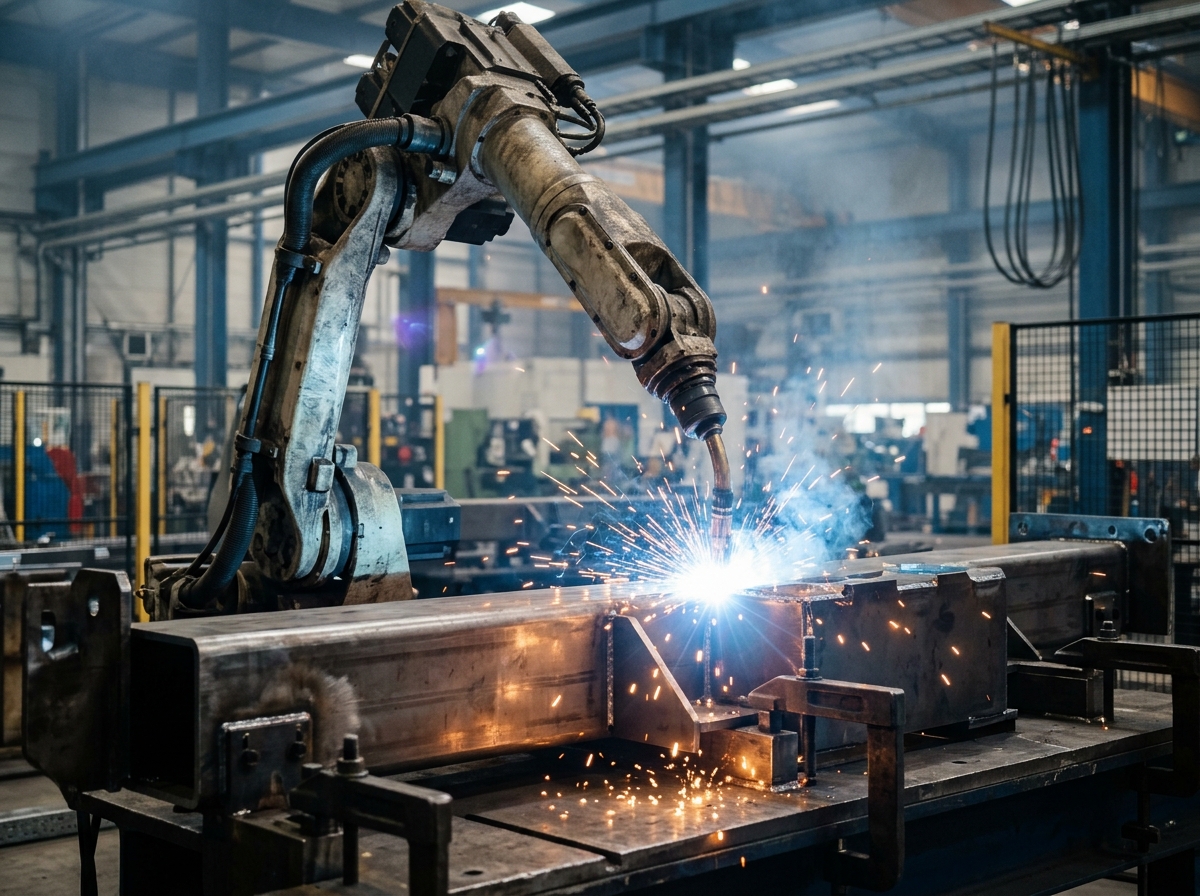
According to industry specialists at Architect Design Welding https://architectdesignwelding.com/, robotic welding is an automated joining process where a programmable industrial robot moves a welding torch or electrode along a part to create a weld. A controller guides the robot’s arm through a pre-taught or digitally mapped path while a power source supplies the heat and current needed to fuse metal.
This approach replaces or supports manual welders on repetitive, high-volume, or hazardous jobs. Factories use it heavily in automotive, aerospace, shipbuilding, and metal fabrication because it delivers consistent welds at a pace humans cannot match.
The technology blends robotics, sensor technology, and control systems into one coordinated unit. Understanding how each piece works together explains why manufacturers keep adopting it despite the upfront investment.
Core Components Of A Robotic Welding System
A robotic welding cell combines several parts that must work in sync for every weld to succeed.
- Robotic arm: a six-axis articulated manipulator that positions the torch at the right angle and distance
- Welding torch or end effector: the tool attached to the arm that delivers the arc, wire, or laser beam
- Controller: the system’s brain, storing the programmed path and adjusting movements in real time
- Power source: supplies the electrical current that creates and sustains the arc
- Wire feeder: pushes filler wire into the weld pool at a steady rate for arc welding processes
- Positioner or fixture: rotates or holds the workpiece so the robot can reach every joint
- Sensors: track the seam, detect part variation, and signal the controller to correct the path
Each component depends on the others, so a weak link anywhere lowers weld quality across the entire cell.
How Robotic Welding Actually Works Step By Step
The process starts long before the torch ever strikes an arc.
Programming The Robot
An operator first teaches the robot its path, either by guiding the arm manually with a teach pendant or by using offline programming software that builds the path from a digital CAD model. Offline programming lets a team plan and test a job without stopping live production. Once the path is confirmed, the controller stores it and repeats it precisely on every identical part.
Positioning And Fixturing
Next, a fixture or positioner holds the workpiece in a fixed, repeatable location. Consistent positioning matters because even small part shifts can throw off weld accuracy. Many cells also rotate the part automatically so the robot can weld multiple sides without re-fixturing.
Sensing And Seam Tracking
Modern systems add vision cameras or laser sensors that scan the joint before and during welding. These sensors feed real-time data back to the controller, which adjusts the torch path to compensate for part tolerance, warping, or fit-up gaps. This seam-tracking capability is what separates a simple pick-and-place robot from a true robotic welding system https://architectdesignwelding.com/reviews/visit-fabtech/.
Welding Execution
With the path set and the seam confirmed, the robot moves the torch along the joint while the power source delivers current and the wire feeder supplies filler material. The arc melts the base metal and filler together, and the pool cools into a solid, uniform weld bead. The entire cycle runs without a human hand touching the torch.
Types Of Robotic Welding Processes
Robotic systems do not rely on one single joining method. Shops choose a process based on material thickness, joint type, and required strength.
- Arc welding (MIG/GMAW and TIG/GTAW): the most common robotic process, ideal for structural steel, aluminum, and stainless parts
- Spot welding: a resistance process that fuses overlapping sheet metal, widely used in car body assembly
- Resistance welding: applies heat through electrical resistance and pressure rather than an open arc
- Laser welding: uses a focused beam for thin materials and precision joints where heat input must stay minimal
- Pulsed arc welding: varies current in pulses to reduce heat distortion on thin or sensitive metals
Many fabrication shops run several of these processes across different robotic cells on the same floor.
Robotic Arms, Cobots, And Payload Capacity
Most industrial welding robots use a six-axis articulated arm because it mimics the flexibility of a human wrist and shoulder. This design lets the torch reach awkward angles that fixed automation cannot handle. Payload capacity, typically measured in kilograms, determines how heavy a torch and cable package the arm can carry without losing accuracy.
Collaborative robots, known as cobots, have grown fast in this space because they work safely alongside people without heavy fencing. A welding cobot usually carries a lighter payload, often in the 3 to 20 kilogram range, which suits small and mid-sized shops running low-volume, high-mix jobs. Traditional six-axis robots still dominate high-volume lines where speed and payload matter more than floor-space flexibility.
Why Manufacturers Invest In Robotic Welding
Shops adopt robotic welding for reasons that go beyond simple labor replacement.
- Precision and repeatability: the robot welds the identical path every time, which cuts rework and scrap
- Productivity: cells can run continuously across shifts without fatigue-related slowdowns
- Worker safety: operators step away from arc flash, fumes, and heat exposure
- Material savings: consistent bead placement reduces wasted filler wire and rework
- Faster throughput: automated cells often weld several times faster than a manual welder on the same joint
These gains compound over time, which is why many companies recover their investment within one to three years depending on part volume.
Challenges And Limitations To Consider
Robotic welding is not a universal fix for every shop floor.
- High upfront cost: a full cell, including the arm, controller, positioner, and safety fencing, requires significant capital
- Programming and training time: staff need real skill to program paths and maintain the system
- Limited flexibility: reprogramming for a brand-new part geometry takes time compared to a human adjusting on the fly
- Part consistency requirements: robots perform best when incoming parts and fixturing stay within tight tolerances
- Maintenance needs: torches, contact tips, and sensors wear down and need scheduled upkeep
Smaller shops often start with one cobot cell before scaling into a fully automated line, which spreads out both the cost and the learning curve.
Industries That Rely On Robotic Welding
Robotic welding shows up anywhere metal parts need strong, repeatable joints at scale.
- Automotive and EV manufacturing: body-in-white assembly, chassis welding, and growing demand for EV battery enclosure welds
- Aerospace: precision welds on lightweight alloys where consistency affects flight safety
- Shipbuilding: large structural welds across thick steel plate
- Construction and heavy equipment: frames, beams, and fabricated structural components
- Electronics and appliances: smaller, high-precision welds on enclosures and components
Automotive and transportation still account for the largest share of robotic welding use worldwide, though EV production is quickly pushing demand higher.
The Future Of Robotic Welding
Robotic welding keeps moving toward smarter, more adaptive systems. Digital twin technology now lets engineers simulate an entire welding cell virtually before building it, which shortens setup time and avoids costly floor-level trial and error. Artificial intelligence is also starting to help robots self-correct welds in real time rather than simply follow a fixed path.
Labor shortages across the welding trade continue to push smaller manufacturers toward cobots and lower-cost automated cells. As robot prices keep dropping and no-code programming tools make setup easier, robotic welding is shifting from a large-factory-only technology into something mid-sized and even small shops can realistically adopt.
Frequently Asked Questions
Is robotic welding better than manual welding?
Robotic welding delivers more consistency and speed, while manual welding still wins for one-off jobs and complex geometry that changes often.
What certification do robotic welding operators need?
Many employers look for the American Welding Society’s Certified Robotic Arc Welding credential for operators and technicians.
How much does a robotic welding system cost?
A complete cell can range from roughly 50,000 dollars for a basic cobot setup to several hundred thousand dollars for a high-payload industrial line.
Can robotic welding handle different metals?
Yes, robotic systems weld carbon steel, stainless steel, aluminum, and copper, though the process and settings change by material.
Do small businesses use robotic welding?
Small shops increasingly adopt cobot-based cells because they cost less, need less floor space, and work safely near human operators.
Final Thoughts
Robotic welding turns a skill-dependent, physically demanding task into a repeatable, programmable process that protects workers and boosts output. As costs drop and programming gets simpler, more shops of every size are bringing a welding cell onto their floor. If your production volume or safety concerns have you weighing automation, start by evaluating one high-repetition weld job as a pilot before committing to a full line.