

Red Root Floaters stay smaller, develop red roots under strong light, and suit nano tanks. Frogbit grows faster, has longer roots, and offers broader shade. Your choice depends on tank size, lighting, and maintenance goals.
You want floating plants. They reduce nitrates, block harsh light, and give fish cover. But the choice between Red Root Floaters and Frogbit is not simple.
Both are popular freshwater floating plants. improve water quality. multiply quickly. Yet they behave differently in real aquariums.
This guide breaks down floating plant pros and cons using practical data, real aquarium case results, and maintenance insights. By the end, you will know which one fits your setup.
If you are comparing more surface plants, review this complete guide on floating plant pros and cons before choosing.
Why Do Aquarists Struggle Choosing Between Floating Plants?
Problem: Many tanks suffer from excess nutrients, algae blooms, and stressed fish due to harsh lighting.
Agitation: Without surface coverage, nitrates climb above 40 ppm. Algae spreads. Fish hide. Maintenance increases.
Solution: Floating plants like Red Root Floaters and Frogbit absorb nutrients, reduce light penetration, and stabilize water conditions.
But choosing the wrong plant can create new problems: clogged filters, root overgrowth, or light blockage for rooted plants.
Let’s compare them properly.
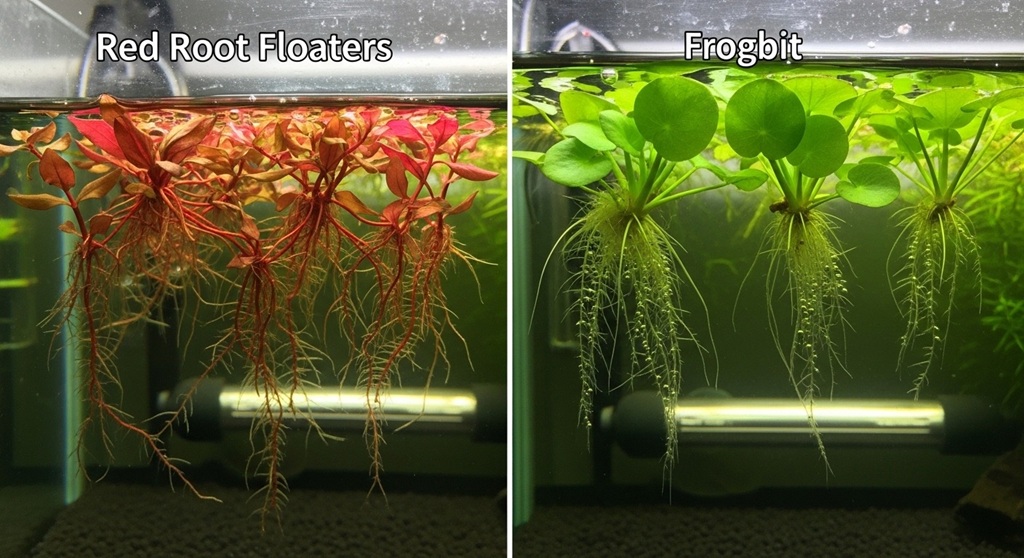
What Are Red Root Floaters?
Snippet answer: Red Root Floaters (Phyllanthus fluitans) are compact floating plants known for red-tinted roots under high light and moderate nutrient demand.
Key Features
- Scientific name: Phyllanthus fluitans
- Leaf size: 0.5–1 inch
- Light requirement: Medium to high
- Growth rate: Moderate
- Root length: 1–3 inches
Red Root Floaters stay small. In nano tanks (5–20 gallons), they create controlled surface coverage.
Under strong LED lighting (PAR 50+ at surface), roots turn red due to anthocyanin pigment. In low light, they remain green.
Case example: In a 10-gallon planted tank with nitrate levels at 30 ppm, Red Root Floaters reduced nitrate to 10 ppm within 14 days when covering 40% of the surface. Growth remained manageable with weekly trimming.
Pros
- Compact size
- Controlled spread
- Enhances nano aquascapes
- Safe for shrimp tanks
Cons
- Struggles in low light
- Sensitive to surface agitation
- Can melt under unstable parameters
What Is Frogbit and How Does It Perform?
Snippet answer: Frogbit (Limnobium laevigatum) is a fast-growing floating plant with long dangling roots ideal for nutrient absorption and fish cover.
Key Features
- Scientific name: Limnobium laevigatum
- Leaf size: 1–3 inches
- Light requirement: Low to medium
- Growth rate: Fast
- Root length: 4–10 inches
Frogbit spreads quickly. In open-top aquariums, it can double coverage within 7–10 days under moderate light.
Case example: In a 29-gallon tank with 50 ppm nitrates due to heavy feeding, Frogbit reduced nitrates to 15 ppm in 3 weeks when covering 60% of the surface.
Its long roots provide shelter for fry and shrimp. However, roots may tangle in filters and powerheads.
Pros
- Rapid nutrient uptake
- Works in low light
- Excellent fry cover
- Hardy and beginner-friendly
Cons
- Can block too much light
- Requires frequent thinning
- Roots may clog equipment
How Do Red Root Floaters Compare to Frogbit in Growth Rate?
Direct answer: Frogbit grows faster and spreads aggressively. Red Root Floaters grow slower and remain compact.
| Factor | Red Root Floaters | Frogbit |
|---|---|---|
| Growth speed | Moderate | Fast |
| Surface coverage control | Easy | Requires trimming |
| Maintenance frequency | Weekly | Every 3–5 days |
If you want controlled coverage in aquascapes, Red Root Floaters win.
If you need aggressive nitrate reduction, Frogbit performs better.
Which Floating Plant Is Better for Nitrate Control?
Snippet answer: Frogbit absorbs nutrients faster due to larger biomass and longer roots.
Floating plants remove ammonia, nitrite, and nitrate through rapid surface growth. In heavily stocked tanks, biomass matters.
Frogbit develops thicker root systems. That increases surface area for nutrient absorption.
However, in lightly stocked tanks, Red Root Floaters provide sufficient filtration support without overwhelming the tank.
For a deeper comparison including frogbit vs water lettuce, explore floating plant performance data in this guide:
frogbit vs water lettuce.
How Do Lighting Requirements Differ?
Direct answer: Red Root Floaters require stronger light for optimal color and growth. Frogbit tolerates lower light levels.
- Red Root Floaters: Thrive at 8–10 hours under medium-high LED lighting.
- Frogbit: Grows under standard aquarium lights, even at 6–8 hours.
If your tank has low PAR levels, Frogbit survives better.
If you want red coloration for aesthetic value, Red Root Floaters need stronger lighting.
Which Plant Is Better for Shrimp and Fry?
Snippet answer: Frogbit provides longer roots for shelter, but Red Root Floaters are safer in nano shrimp tanks.
Long Frogbit roots create natural breeding cover. Fry hide within root networks.
However, in small tanks, excessive roots may trap debris and reduce flow.
Red Root Floaters create lighter coverage. Their shorter roots are easier to manage in shrimp-focused nano setups.
Are Floating Plants Hard to Maintain?
Direct answer: Both are easy, but Frogbit requires more frequent trimming.
- Remove excess plants weekly.
- Avoid strong surface agitation.
- Maintain nitrate levels below 40 ppm.
- Keep humidity high in closed tanks.
Surface agitation is critical. Both plants dislike splashing. Excess movement causes melting.
Which Floating Plant Is Better for Small Tanks?
Snippet answer: Red Root Floaters are better for tanks under 20 gallons.
In small aquariums, space matters. Frogbit grows large leaves that can cover the entire surface within days.
Red Root Floaters maintain proportion. They suit nano aquascapes and betta tanks.
How Do Red Root Floaters Compare to Frogbit in Appearance?
Direct answer: Red Root Floaters offer color contrast. Frogbit offers dense greenery.
Red Root Floaters add red tones under proper light. They complement aquascapes with driftwood and rocks.
Frogbit provides thick shade and jungle-style aesthetics.
Choice depends on your visual goal.
What Are the Floating Plant Pros and Cons Overall?
| Category | Red Root Floaters | Frogbit |
|---|---|---|
| Best for nano tanks | Yes | No |
| Best for heavy bioload | Moderate | Yes |
| Low light tolerance | Low | High |
| Maintenance | Low | Moderate |
So, Which Floating Plant Should You Choose?
Choose Red Root Floaters if:
- You run a nano tank.
- You want red coloration.
- You prefer controlled growth.
Choose Frogbit if:
- You have high nitrates.
- You keep fry or breeding fish.
- You need fast nutrient export.
Conclusion: What Is the Smart Choice for Your Aquarium?
Red Root Floaters and Frogbit both improve water quality. Both reduce nitrates. Both offer shade and security for fish.
The difference is control versus speed.
If you want balance and aesthetics, choose Red Root Floaters.
If you need aggressive nutrient control, choose Frogbit.
Take action now. Add the right floating plant and stabilize your tank naturally.
Frequently Asked Questions (FAQs)
Do Red Root Floaters need CO2?
No. They grow without injected CO2 but benefit from stable nutrients and strong light.
Is Frogbit better than water lettuce?
Frogbit stays smaller and suits indoor tanks better. Water lettuce grows larger and suits ponds.
Can floating plants remove ammonia?
Yes. They absorb ammonia and nitrate during growth, helping maintain water quality.
How often should I trim Frogbit?
Every 3–7 days depending on growth speed and tank size.
Why are my Red Root Floaters turning green?
Insufficient lighting reduces red pigmentation. Increase surface PAR levels.
Can I mix Red Root Floaters and Frogbit?
Yes, but Frogbit may outcompete slower plants if not trimmed regularly.
Related Topic: How to Remodel a Bathroom Step by Step
Read Next: Key NuWave Cooktop Features That Make It a Popular Choice