
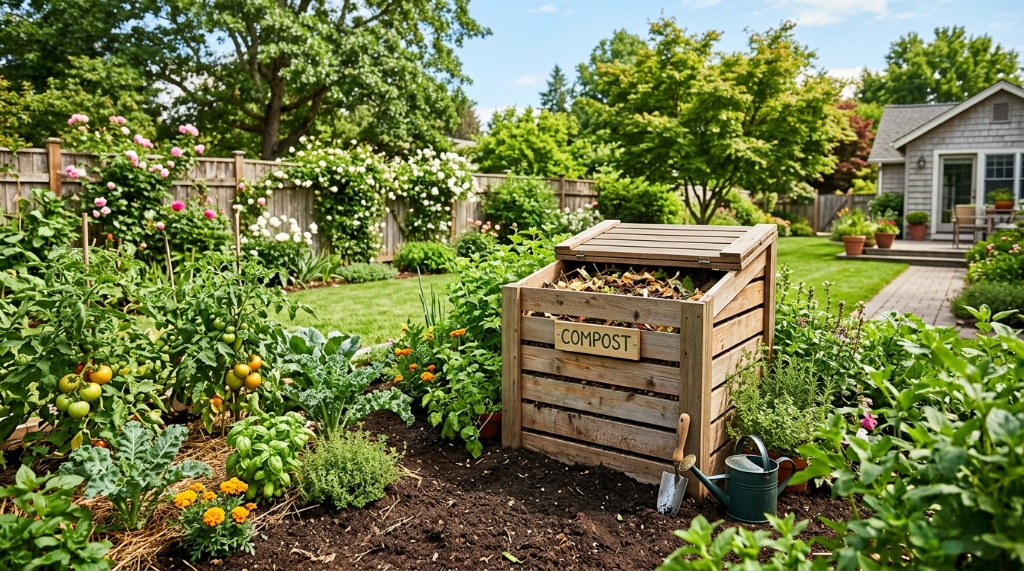
Every week, the average household throws away a staggering amount of food scraps, coffee grounds, and yard trimmings, all of which end up in landfills where they generate methane. What if that waste could become a resource instead? Backyard composting turns kitchen and yard debris into a rich soil amendment while dramatically shrinking what you send to the curb. If you want to make sure you’re setting up the right system from the start, check out this review of a practical composter option for a Pennsylvania backyard. But first, let’s look at exactly how composting reduces organic waste and what that means for your household.
Quick Answer
Backyard composting reduces household organic waste by diverting food scraps, yard trimmings, and paper products from landfills, where they would otherwise decompose anaerobically and produce methane. Instead, these materials break down into a useful soil amendment. A typical household can divert a significant portion of its waste stream this way, reducing trash volume, lowering collection costs in some programs, and creating free compost for gardens or landscaping.
Key Takeaways
- Composting diverts organic material from landfills, where it contributes to methane emissions.
- Kitchen scraps, yard waste, and certain paper products are all suitable for backyard composting.
- The biggest reductions come from consistently separating organics at the source rather than occasional participation.
- Finished compost improves soil structure, retains moisture, and reduces the need for synthetic fertilizers.
- Odor and pest issues are usually the result of an imbalanced mix, not composting itself.
What Counts as Organic Waste in a Typical Household
Before you can reduce organic waste, you need a clear picture of what it includes. Most households generate far more than they realize.
The main categories are:
- Food scraps: vegetable peels, fruit cores, coffee grounds, tea leaves, eggshells, stale bread, and leftover cooked food (in moderation).
- Yard waste: grass clippings, dry leaves, small branches, spent plants, and weeds without seeds.
- Paper and cardboard: uncoated paper, newspaper, paper towels, and plain cardboard, which count as browns.
- Other compostable items: dryer lint, hair, and certain pet fur, though these are minor contributors.
What most households find is that food scraps and yard trimmings make up a substantial share of their weekly trash. By weight, organics are often one of the largest single categories in the waste stream. That means even a modest composting routine can meaningfully change how much your household throws away.
One important distinction: not all organic waste is compostable at home. Meat, dairy, oils, and pet waste are technically organic but can attract pests and create odors in a backyard bin. Many municipal programs accept them, but home composters usually skip them unless using a specialized system.
Why Landfill Disposal Is a Problem
When organic material goes to a landfill, it doesn’t decompose the way it does in a compost pile. Landfills bury waste, limiting oxygen. Without oxygen, decomposition is anaerobic, which produces methane — a potent greenhouse gas. Landfills are a major source of human-caused methane emissions, and organic waste is a primary driver.
This is the core environmental argument for backyard composting. You’re not just reducing trash volume; you’re preventing a specific chemical process that harms the atmosphere.
There’s also a practical angle. Organic waste in landfills creates leachate — a liquid that can contaminate groundwater if not properly managed. Composting at home sidesteps both the atmospheric and water-quality issues while producing a useful product.
The trade-off is space and effort. Not everyone has a yard or the time to manage a pile. For those situations, worm bins or municipal food-waste collection programs are worth considering, though they have their own limitations, Before setting up your outdoor bins, it is also smart to check your indoor plumbing systems so you can find and fix common household water leaks to conserve resources all around your property.
How Much Waste Can You Actually Divert?
The honest answer: it depends on your household size, diet, and yard habits. A family that cooks frequently and has a landscaped yard will generate more compostable material than a single apartment dweller.
General patterns worth knowing:
- Food scraps alone often make up a meaningful share of kitchen trash by weight.
- Yard waste varies seasonally, with spring and fall producing the largest volumes.
- Paper and cardboard can add significant bulk if you choose to compost them.
Rather than guess, try a simple experiment. For one week, collect your compostable materials in a separate bin and weigh or eyeball it. Compare that to your total trash. Most people are surprised by the proportion. That number gives you a realistic sense of what composting could divert.
Setting Up a System That Actually Reduces Waste
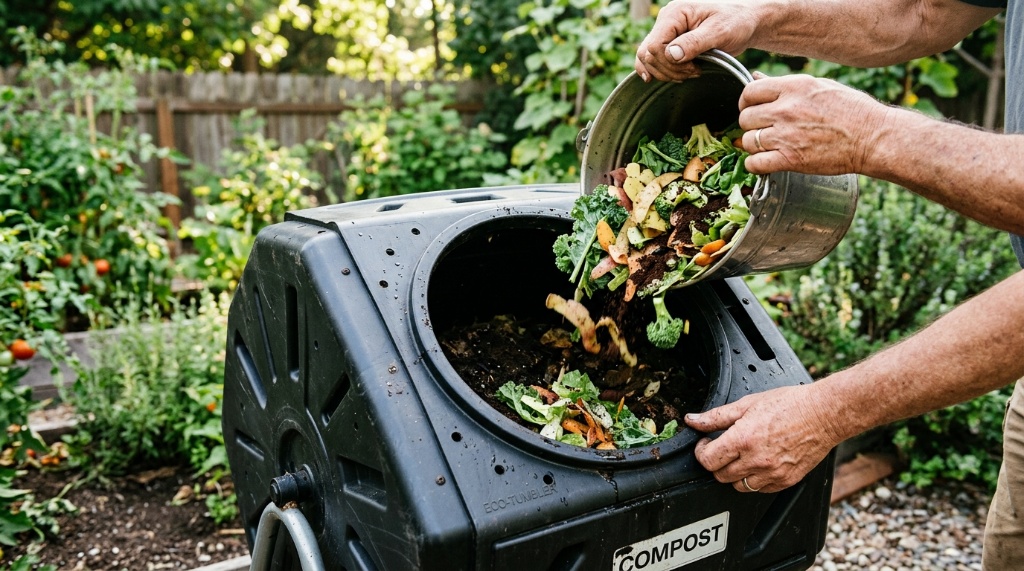
Reduction only happens if the system is convenient enough to use consistently. The best bin or pile is the one you’ll actually maintain.
Choose the right size and type
Options range from simple open piles and wire bins to enclosed tumbling composters and stationary units. A tumbler makes turning easier but typically holds less volume. A stationary bin holds more but requires manual turning with a fork. Open piles are cheapest but can be less tidy and more attractive to animals.
The right choice depends on how much material you generate, how much space you have, and how much effort you’re willing to invest. In areas with wildlife pressure, enclosed bins are usually the safer bet.
Balance greens and browns
Composting works best with a roughly balanced mix of nitrogen-rich “greens” (food scraps, grass clippings) and carbon-rich “browns” (dry leaves, cardboard, wood chips). Too many greens and the pile gets slimy and smelly. Too many browns and it breaks down slowly.
A practical rule: if it smells bad, add browns. If it’s not heating up, add greens or turn it.
Manage moisture and aeration
Compost should feel like a wrung-out sponge — damp but not dripping. Turn the pile occasionally to introduce oxygen. In dry climates, you may need to water it. In wet climates, covering the pile helps prevent it from becoming waterlogged.
Common Mistakes That Undermine Waste Reduction
Many people start composting enthusiastically and then quit because of avoidable problems.
- Adding the wrong materials: Meat, dairy, and oils slow decomposition and attract pests.
- Letting the pile get too wet or too dry: Both stall the process.
- Not turning the pile: Without oxygen, decomposition slows and odors develop.
- Using a bin that’s too small: Small volumes struggle to retain heat, especially in cold weather.
- Giving up in winter: Composting slows in cold temperatures but rarely stops entirely. Insulating the pile or using a larger bin helps.
Addressing these early makes the difference between a system that reduces waste consistently and one that becomes a forgotten corner of the yard.
What Composting Doesn’t Solve
Backyard composting is effective, but it’s not a complete waste solution. It handles organic material only. Plastics, metals, glass, and synthetic textiles still require recycling or landfill disposal. Composting also doesn’t eliminate the need to reduce food waste at the source — buying less and using what you buy remains the most direct way to cut waste.
There’s also a practical limit to capacity. A small backyard bin can only process so much. Households generating large volumes may need multiple bins, a larger system, or a combination of home composting and municipal collection.
Finally, composting requires some ongoing attention. It’s not a “set and forget” process if you want good results. That said, the effort is modest once you establish a routine.
Frequently Asked Questions
What can I compost at home?
Fruit and vegetable scraps, coffee grounds, tea leaves, eggshells, grass clippings, dry leaves, and plain cardboard are all good candidates. Avoid meat, dairy, oils, and pet waste in most home systems.
How long does it take to make compost?
With regular turning and a good balance of materials, compost can be ready in as little as two to three months. Passive piles may take six months to a year.
Does composting smell bad?
A properly balanced compost pile should smell earthy, not foul. Bad odors usually indicate too many greens, too much moisture, or insufficient turning.
Can I compost in winter?
Yes, though decomposition slows significantly. You can continue adding material, and the pile will resume active decomposition when temperatures rise.
Do I need a bin, or can I just make a pile?
Both work. A bin contains the material, discourages pests, and looks tidier. An open pile is simpler and cheaper but requires more space and management.
Is composting worth it for a small household?
Yes. Even a small household can divert a meaningful amount of food scraps. A compact worm bin or small tumbler works well when space is limited.
Conclusion
Backyard composting is one of the most direct ways to shrink your household’s organic waste footprint. By separating food scraps and yard trimmings, you reduce landfill methane emissions, cut trash volume, and produce free compost for your garden. Success depends on choosing a system that fits your space and habits, balancing greens and browns, and sticking with a simple routine. Start small, adjust as you go, and let the pile do the rest.


