
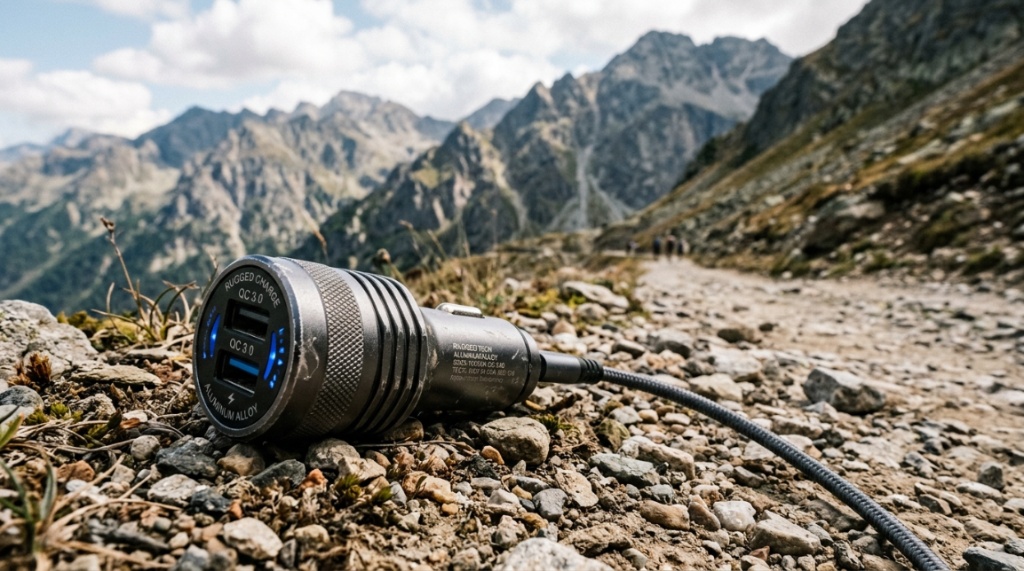
You’re halfway up a winding mountain road, your GPS is guiding you through the switchbacks, and your phone—your lifeline for maps, music, and emergency calls—drops to 5% battery. You plug it into your car charger, and nothing happens. The charger gave up, likely due to the extreme vibrations, temperature swings, and voltage fluctuations common at high altitudes. This isn’t just an inconvenience; it’s a safety risk. Mountain driving demands equipment that can withstand harsh conditions, yet most standard chargers fail within months. You need a unit built for the rugged environment—one that delivers consistent power, survives physical stress, and protects your devices. In this guide, I’ll show you exactly what separates a fragile charger from a mountain-proof one.
What Makes a Standard Car Charger Fail on Mountain Roads?
Standard car chargers are designed for smooth city commutes and mild weather, not the punishing realities of high-altitude driving. The primary culprits behind failure are physical stress from rough terrain, extreme thermal cycling, and unstable vehicle electrical systems. You cannot simply grab any charger and expect it to survive a season of mountain adventures.
Physical Stress and Vibration Damage
When you drive over potholes, gravel, or rocky ascents, your charger experiences continuous micro-shocks. Inside a cheap charger, solder joints crack, coils break loose, and connectors loosen. Over time, this internal damage leads to intermittent charging or complete failure. A durable charger uses epoxy-filled internals or solid-state components that resist vibration damage, ensuring the circuit board stays intact even on the bumpiest forest service roads.
Temperature Extremes at High Altitude
Mountain environments present a unique paradox: intense UV exposure in the day and freezing temperatures at night. Inside a closed vehicle, temperatures can swing from -10°F to 140°F in a single day. These swings cause thermal expansion and contraction, which breaks solder joints and degrades cheap plastic housings. Premium chargers use flame-retardant, thermal-resistant materials that maintain structural integrity across a wide temperature range.
Voltage Fluctuations from Aging Alternators
At higher RPMs during steep climbs, your vehicle’s alternator can output voltage spikes above 16 volts. A charger not built to handle this surge can overheat or fry your phone. Conversely, during idle or accessory mode, voltage drops can cause the charger to cut out entirely. Industrial-grade chargers incorporate voltage regulators and surge protection circuits that smooth out these fluctuations, delivering stable 5V/3A output regardless of engine load.
Which Materials and Build Features Matter Most for Durability?
Material quality is the single most significant predictor of a charger’s lifespan in mountain conditions. Look beyond the price tag and examine the construction details. An aluminum alloy body, for instance, dissipates heat far better than plastic, and it provides a rigid housing that resists deformation. Combined with reinforced USB ports and strain-relieved cables, these features determine whether your charger lasts one season or five. If you ever encounter power issues or LED indicators while charging devices on the go, What Do Flashing Lights on Shark Battery Charging Mean for troubleshooting tips.
Aluminum Alloy vs. Plastic Housings
Aluminum housings offer superior heat dissipation, pulling heat away from internal components during heavy charging. They also resist UV degradation, which causes plastic to become brittle and crack after prolonged sun exposure. While aluminum is more expensive, it provides the structural rigidity needed to protect internal components during vibrations. You should always verify that the charger uses a solid machined body, not just a thin metal coating over plastic.
Military-Grade Connectors and Gold-Plated Pins
The connection points are the most vulnerable part of any charger. Gold-plated pins resist corrosion from humidity and temperature condensation, ensuring a consistent electrical connection. Military-grade connectors feature reinforced stress points that prevent the tip from bending or snapping off inside your vehicle’s 12V socket—a common failure point on rough terrain. When shopping, check for connectors rated for at least 10,000 insertion cycles.
IP Rating and Dust/Water Resistance
Mountain driving kicks up dust, dirt, and moisture that can infiltrate a poorly sealed charger. An IP54 rating or higher indicates solid protection against dust ingress and water splashes. This is essential when you frequently drive with windows down or encounter sudden rainstorms. A sealed charger also prevents internal corrosion from humidity, which is a slow killer of electronics in alpine environments.
How Many Ports and What Power Output Do You Actually Need?
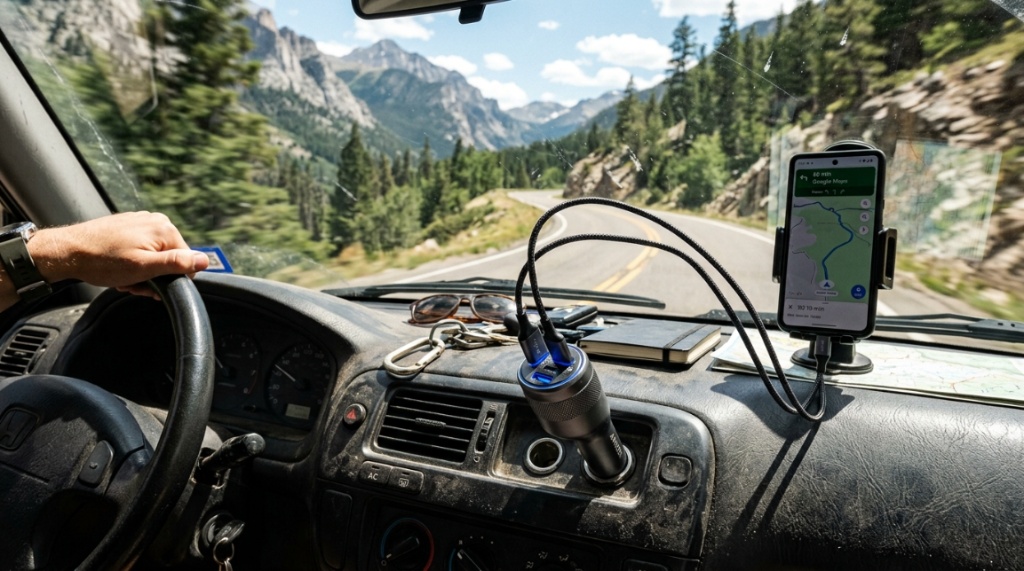
For mountain drives, you need at least 30W of total output, preferably with one USB-C power delivery port and one USB-A Quick Charge port. This ensures you can power a modern smartphone at full speed while simultaneously running a secondary device like a dashcam or GoPro. Underpowered chargers that deliver only 5W are practically useless for navigation-heavy trips.
The Case for Dual-Port Chargers
In a mountain-drive scenario, you typically have multiple devices draining battery: your primary phone, a secondary phone for work, a portable Wi-Fi hotspot, or a passenger’s tablet. A dual-port charger allows simultaneous fast charging without sacrificing speed. However, beware of cheap dual-port units that split the total wattage, slowing both devices. High-quality units provide dedicated full-speed ports that operate independently.
USB-C Power Delivery vs. Standard USB-A
USB-C Power Delivery (PD) is the modern standard for quick charging, enabling up to 100W output. It intelligently negotiates power delivery between the charger and device, adjusting voltage and current dynamically. This is crucial for newer smartphones that support 25W+ fast charging. Standard USB-A with Quick Charge 3.0 is also useful for older devices, but it’s slower. Prioritize a charger with at least one USB-C PD port rated at 30W or higher.
Understanding Amperage Ratings
Amperage determines how quickly your device charges. For a phone in active GPS navigation mode, you need at least 2.4A to maintain battery level or charge slowly. A charger delivering 3A per port is ideal, as it can handle power-hungry apps while keeping the battery topped up. Anything less than 2A will likely see your battery continue draining, albeit slower than without a charger.
Is Fast Charging Safe for Your Phone During Long Climbs?
Yes, fast charging is safe, provided the charger has proper thermal management. Modern phones and chargers communicate to regulate heat output. However, the risk increases in hot vehicles. A durable charger incorporates temperature sensors that reduce charging speed if the unit exceeds safe operating temperatures. Fast charging only becomes an issue when the charger lacks these protections.
Thermal Throttling and Overheat Protection
Advanced chargers include IC chips that monitor temperature in real-time. If the charger reaches a threshold around 140°F, it automatically reduces output to prevent component failure. This feature not only protects the charger itself but also prevents your phone from overheating, which can permanently degrade battery health. You should always select chargers with built-in safety certifications like CE, FCC, and RoHS.
Battery Health Considerations for Long-Term Use
Constantly charging at maximum speed can degrade your phone’s battery over time. Many modern chargers include multi-stage charging protocols that taper the current as the battery approaches full capacity. This is safer than trickle-charging at high amperage, which causes lithium-ion cells to heat up. For extended mountain trips, choose a charger that provides intelligent power management rather than raw, uncontrolled power output.
When Should You Replace Your Car Charger Before a Mountain Trip?
Replace your charger immediately if you notice loose connections, sparking, excessive heat, or intermittent charging. These symptoms indicate internal damage that could eventually fail completely. Additionally, any charger with visible cracks, bent plugs, or frayed cable fibers should be retired. The cost of a replacement is trivial compared to the danger of being stranded without navigation in a remote area.
Signs of Impending Charger Failure
If your phone charges only when the plug is held at a certain angle, the internal USB connector is failing. A charger that remains hot to the touch after a few minutes is operating under excessive resistance, which can lead to melting or fire in extreme cases. Similarly, a charger that produces a faint buzzing sound may have failing internal components that could short-circuit.
How Often Should You Inspect Your Charger?
Conduct a physical inspection every month if you drive mountainous terrain regularly. Check the 12V plug for bent pins and the housing for cracks. Look inside the USB ports for debris or corrosion. This five-minute check can prevent an emergency on the trail. Consider replacing budget chargers annually, regardless of appearance, while premium units can last three to five years with proper care.
Why Does Cable Quality Matter as Much as the Charger Itself?
The cable connecting your charger to your phone is the weakest link in the chain. A high-quality charger with a flimsy cable will still deliver inconsistent power or fail entirely. Cables designed for mountain use feature braided nylon exteriors that resist abrasion and provide tensile strength. Investing in a reinforced cable is as important as selecting the right charger.
Braided Nylon and Kevlar Fiber Reinforcements
Braided nylon cables offer superior flexibility and resistance to tangling compared to standard PVC cables. The tight weave protects internal wire conductors from the stresses of bending, pulling, and temperature changes. Some premium cables incorporate Kevlar fiber strands, which provide five times the tensile strength of steel, making them virtually impossible to snap during stressful use.
Cable Length and Gauge Considerations
For mountain drives, a cable length of 1.5 to 2 meters is optimal, allowing you to use your phone comfortably while plugged in. However, longer cables increase resistance, which can reduce charging speed. To maintain proper performance, choose cables with a 20 AWG or thicker power wire gauge. Thinner 28 AWG wires suffer significant voltage drops over distance, resulting in slower charging.
Which Certifications Guarantee a Durable Car Charger for Mountains?
Certifications are your assurance that a charger has been independently tested for safety and performance. The most critical certifications include UL (Underwriters Laboratories), CE (Conformité Européenne), and FCC (Federal Communications Commission). These mark what ensures electromagnetic interference is controlled, thermal limits are respected, and fire safety standards are met. A charger lacking these certifications is a gamble you should not take.
Understanding UL Certification for Automotive Electronics
UL certification is the gold standard for electronic safety, particularly in automotive environments. Products bearing this mark have undergone rigorous testing for fire, shock, and environmental hazards. UL-certified chargers include robust internal fusing and temperature cutoff switches that prevent catastrophic failures. Always check for the UL mark on the product or packaging, as it is rarely imitated by counterfeit goods.
Why FCC Compliance Matters
FCC certification ensures that the charger does not emit harmful electromagnetic interference that could disrupt your vehicle’s sensitive electronic systems, including navigation or engine control modules. An uncertified charger can cause erratic dashboard behavior or interfere with your phone’s GPS signal. Certified chargers include proper shielding and filtering components to ensure clean power output.
How Do You Test a Car Charger Before Committing to a Mountain Trip?
Before leaving your garage, test your charger under simulated load to verify its real-world performance. This simple process can reveal hidden faults that aren’t apparent during casual use. Running a diagnostic test takes less than five minutes and provides confidence in your equipment.
Using a USB Power Meter for Real Output Measurement
Purchase a USB power meter that plugs inline between your charger and phone. These inexpensive devices display real-time voltage, amperage, and wattage. During the test, use your heaviest charging scenario—a low-battery phone with GPS enabled. If the meter shows the rated wattage, your charger is functioning correctly. If output is significantly lower than rated, internal components are likely degraded.
Performing a Heat Stress Test
Plug the charger in and run a demanding app like navigation for 30 minutes while connected. After this period, carefully touch the charger housing. It should be warm but not painful to touch. If the charger becomes excessively hot, it lacks proper thermal management and will likely fail under the stress of continuous mountain driving. This test simulates the continuous load of a long climb.
What Is the Ideal Price Range for a Mountain-Grade Charger?
Expect to invest between $25 and $50 for a truly durable car charger that meets all mountain requirements. While you can find budget options under $10, they generally cut corners on components, leading to premature failure. Conversely, any charger above $60 is either overpriced or includes premium features—such as built-in dash cam ports—that may not be necessary for your application.
Budget Options vs. Premium Reliability
Budget chargers in the $10–$15 range typically feature plastic housings, standard connectors, and minimal surge protection. They work adequately for occasional city use but frequently fail on the first rough trail. Premium chargers in the $30–$50 range invest in machined aluminum bodies, military-grade components, and comprehensive safety features. The longevity difference is substantial—premium units often outlast three budget replacements.
Evaluating Brand Reputation and Warranties
Established brands like Anker, Aukey, and Belkin offer reliable products backed by 18- to 24-month warranties. These companies stand behind their products, indicating confidence in manufacturing quality. In contrast, generic brands with 30-day warranties signal low confidence. A robust warranty is your guarantee of durability, as the manufacturer will replace units that fail under normal mountain-driving conditions.
Can Regular Car Chargers Handle the Cold Temperatures of Mountain Winters?
Most quality car chargers can operate correctly in cold temperatures as low as -22°F, but the chemical properties of capacitors and semiconductors can change below freezing. This may result in slower charging or temporary instability. Chargers designed for cold environments use industrial-grade components rated for the extended temperature range, ensuring reliable operation no matter the climate.
Cold-Weather Charging Behavior and Limitations
In sub-zero temperatures, lithium-ion batteries accept charge much slower due to increased internal resistance. This behavior is normal and not a charger defect. However, jump-starting a frozen vehicle can cause massive voltage spikes that damage unprotected chargers. Look for chargers with built-in surge protection rated for at least 20V to handle these extreme spikes during winter emergency starts.
Maintaining Charger Performance in Freezing Conditions
To maintain charger performance in winter, plug your charger in for a few minutes before starting the engine to allow it to warm up internally. This reduces thermal shock to components. Additionally, ensure your 12V socket is clean and free of oxidation, as cold weather exacerbates poor connections. Using a dielectric grease on the plug terminals can prevent corrosion and maintain conductivity.
Where Should You Mount Your Car Charger for Maximum Protection?
Mount your charger in the primary 12V socket, not an extension adapter. Intermediate connections create additional resistance and potential failure points. In vehicles with multiple sockets, choose one protected from direct sunlight and physical contact from knees or bags. The optimal position is horizontal, preventing gravitational pull on the connection during steep inclines.
Avoiding OBD-II Port Adapters
Some drivers use OBD-II port adapters for charging, but these are a bad idea for mountain driving. The OBD-II port’s wiring is not designed for continuous high-current draw, and your throttle body or fuel injection systems may malfunction. Additionally, you may accidentally interrupt the diagnostic signals of your vehicle’s ECU. Always use a defined 12V accessory outlet for charging.
Managing Cable Pathways to Prevent Snagging
Route your charging cable behind interior trim panels where possible to prevent snagging on pedals or steering components. Never leave a cable loose in the footwell, as it can interfere with braking pedals. Using clip-mounted cable retainers along the center console keeps the cable secure and prevents stress on the charger’s connection, improving longevity and safety simultaneously.
Are There Specific Brands Known for Mountain-Proven Durability?
Anker and AUKEY are the most consistently recommended brands for durable automotive electronics, with specific models engineered for harsh environments. These brands utilize aerospace-grade materials and rigorous testing protocols. Other notable mentions include Scosche and PowerDrive, which specialize in rugged designs. You can browse specific models and user feedback to find the best fit for your vehicle.
Anker’s Ruggedized Series and Its Capabilities
Anker’s high-end chargers, such as the Roav Power Adaptor, feature proprietary voltage-boosting technology that stabilizes output even when car voltage fluctuates wildly. These units are tested to withstand 1,000+ vibration cycles and operate between 14°F and 122°F without performance degradation. Their use of aluminum alloy construction places them among the most physically robust options available.
Aftermarket vs. OEM Charger Comparisons
Original Equipment Manufacturer (OEM) chargers from your vehicle brand are not necessarily superior. Car manufacturers rarely produce chargers in-house; they rebrand third-party products. Third-party specialists like Anker focus entirely on charging technology, giving them an expertise advantage. Unless your OEM charger includes specific vehicle integration features, a high-quality aftermarket unit will likely offer superior durability. For a detailed comparison of leading models, I recommend checking this resource on the best durable car charger for mountains designed for Colorado terrain.
User Reviews as a Reliability Indicator
Before purchasing, read reviews specifically mentioning long-term use after 6-12 months. Early reviews often reflect initial impressions, not long-term durability. Look for patterns of consistent performance across different vehicle models and geographic regions. A charger that performs well for users in Colorado, the Rockies, and the Alps likely has the durability you need.
Frequently Asked Questions
Can I use a 65W laptop charger in my car for my phone?
Yes, but only if the charger supports USB Power Delivery negotiation. A 65W charger can deliver lower wattage (like 18W or 20W) to a compatible phone safely. However, the charger must be specifically designed for automotive use with proper surge protection, not just a repurposed wall charger with a car adapter.
How long does a premium car charger typically last?
A premium car charger designed for rugged use can last between 3 and 5 years with regular use. Environment plays a significant role—frequent off-road driving will shorten lifespan, while highway driving will extend it. Budget chargers typically last 6 to 12 months under the same conditions. Regular inspection extends longevity.
Do all car chargers work at high altitudes above 10,000 feet?
Yes, altitude itself does not directly affect charger operation, since the electronics are sealed. However, the correlated temperature extremes and thin air reduce natural cooling efficiency. At high altitudes, a charger runs hotter because air is less dense and holds less heat. This makes thermal management features even more critical for reliability in alpine environments.
Is it safe to fast-charge while using high-power navigation apps?
It is completely safe. Modern phones manage internal heat effectively, and fast charging while navigating is a standard use case. The phone will automatically reduce charging speed if it detects excessive heat to protect the battery. The charger’s output remains constant, providing the phone with the maximum energy it accepts safely.
What should I do if my charger smells like burning plastic?
Unplug it immediately and discontinue use. A burning plastic smell indicates serious internal overheating, often from short-circuited components or poor insulation. Continuing to use the charger can cause a fire risk. Replace it promptly, and inspect your vehicle’s cigarette lighter socket for signs of melting or debris that could have caused the failure.
Can I charge my action camera and drone batteries simultaneously?
Yes, if your charger provides adequate total wattage. Charging a GoPro-style camera (up to 18W) and a drone battery (up to 60W) simultaneously requires a charger with at least 80W total combined output. Most phone-focused chargers cannot handle this load, so you need a specialized high-output model for such a scenario. Verify each port’s peak output before attempting this.