

The best bike phone mount should hold your phone firmly, keep navigation visible, and protect it from road vibration. For most riders, a secure handlebar mount with a strong locking mechanism, adjustable viewing angle, and vibration control offers the best balance. Your ideal mount also depends on your phone size, handlebar diameter, riding surface, and daily route.
Why Your Phone Mount Matters More Than It Seems
A phone mount does more than keep your smartphone within reach. It creates a direct connection between your navigation app and your riding position. Therefore, poor mounting hardware can turn a useful navigation tool into a distraction.
Safety also deserves attention because cyclists have little physical protection during traffic crashes. NHTSA reports that 1,103 bicyclists died in traffic crashes in 2024, which shows why riders should keep their attention on the road.
A good mount should support quick glances rather than constant screen watching. It should also keep the phone stable enough for you to read directions without repeatedly adjusting it.
Start With Your Riding Style
Before comparing mounts, define how you actually ride. A commuter, weekend cyclist, gravel rider, and mountain biker place different demands on mounting hardware.
Ask yourself these questions:
- Where do you usually ride?
- How often do you use navigation?
- Do you ride on smooth pavement or rough trails?
- Do you use a phone case?
- Do you remove your phone frequently?
- Do you ride in rain or dusty conditions?
- Do you record rides with your phone camera?
Your answers quickly eliminate unsuitable designs. For example, a basic clamp may work perfectly for casual pavement riding but struggle on rough trails.
Understand the Main Types of Bike Phone Mounts
Different mount designs solve different problems. Understanding their construction makes comparison much easier.
Handlebar Clamp Mounts
Handlebar clamp mounts attach directly around the handlebar. They remain popular because they offer simple installation and broad compatibility.
They work especially well for commuting, fitness riding, and everyday navigation. However, you should confirm the mount supports your handlebar diameter before buying.
Stem Mounts
Stem mounts position the phone closer to the center of the bike. This location often creates a cleaner cockpit and keeps the screen aligned with your natural sightline.
They can also work well on bikes with crowded handlebars. Still, check your stem dimensions because some designs require specific mounting space.
Case Based Mounts
Case based systems use a dedicated phone case that connects to a mounting interface. They usually provide a secure connection while allowing quick attachment and removal.
This design suits riders who use navigation frequently. However, you need to consider whether you want to replace your everyday phone case with a specialized case.
Universal Grip Mounts
Universal mounts use adjustable arms, silicone straps, or similar mechanisms. They can accommodate different phones without requiring a dedicated case.
Their flexibility makes them convenient for households with multiple phones. Nevertheless, examine the locking mechanism carefully because convenience should never replace security.
Prioritize Stability Before Convenience
A bike phone mount exists primarily to keep your phone secure. Therefore, stability should come before appearance, price, or installation speed.
Look for a mount that creates several points of contact with the phone. A single weak gripping point can allow movement when the bicycle encounters potholes or rough pavement.
The mounting interface matters equally. A strong phone holder attached to a flexible handlebar clamp can still produce excessive movement.
Check the Locking Mechanism
The locking system should feel deliberate and secure. Avoid designs that depend entirely on friction without a clear retention feature.
A mechanical latch, locking tab, or secure twist mechanism generally provides more confidence. After installation, test the connection before placing your phone on it.
Give the phone a firm manual shake while the bike remains stationary. If the mount shifts significantly, reconsider the installation or the mount itself.

Pay Attention to Vibration Control
Road vibration affects both your phone and your viewing experience. Rough pavement, gravel, potholes, and repeated impacts can transmit considerable movement through the handlebar.
Vibration control becomes especially important when your smartphone contains optical image stabilization. Apple warns that certain high amplitude vibrations can affect iPhone camera systems, although its guidance specifically addresses high powered motorcycle vibration.
A bicycle does not create the same vibration profile as a powerful motorcycle. Still, riders who frequently travel rough surfaces should consider a mount with vibration damping.
Look for these features:
- Flexible vibration isolators
- Damping inserts
- Shock absorbing interfaces
- Secure mounting hardware
- A rigid connection combined with controlled phone movement
Do not assume that softer always means better. Excessive flexibility can make navigation difficult because the screen moves constantly.
Match the Mount to Your Phone
Phone dimensions vary considerably, even within the same product family. Therefore, check the mount’s supported width, height, thickness, and weight.
Your phone case matters too. A mount that fits a bare phone may struggle with a rugged protective case.
Before purchasing, measure the complete setup you actually ride with. That simple step prevents many compatibility problems.
Consider Camera Clearance
Some mounts grip the phone around its edges. Others use a rear mounting interface attached to a dedicated case.
Edge gripping designs can interfere with buttons or camera controls if their dimensions do not match your phone. Case based systems usually solve this problem more cleanly.
If you frequently record rides, check the camera area before buying. A mount should not obstruct your lenses or force the phone into an awkward angle.
Choose the Right Viewing Angle
A secure phone becomes much less useful if you cannot see it comfortably. The screen should sit where you can make brief glances without significantly changing your riding position.
An adjustable mount gives you more control over glare, reflections, and viewing position. However, excessive articulation can introduce unwanted movement.
A good adjustment system should lock firmly after positioning. Once you find your preferred angle, the phone should remain there throughout the ride.
Think About Landscape and Portrait Navigation
Navigation apps often work well in both portrait and landscape orientation. Your preferred orientation depends on how you use maps and what information you want visible.
Portrait orientation often provides a longer view of the upcoming route. Landscape orientation can provide a wider view of turns, roads, and surrounding map details.
Choose a mount that allows rotation if you regularly switch between orientations. Make sure the rotation mechanism locks securely instead of relying on loose friction.
Check Handlebar Compatibility
Handlebars come in different shapes, diameters, and available mounting spaces. Therefore, compatibility involves more than simply asking whether a mount fits a bicycle.
Measure your handlebar before purchasing. Also inspect the space around brake levers, shifters, lights, bells, and other accessories.
A mount may technically fit but still interfere with another component. That situation can make installation uncomfortable and compromise cockpit organization.
Evaluate Installation and Removal
A mount should not require a complicated process every time you use your bicycle. Frequent riders benefit from systems that attach securely while remaining easy to remove.
Tool free clamps can simplify installation between bicycles. Meanwhile, fixed hardware can provide better security for riders who leave the mount installed permanently.
Consider how often you switch bikes. If you own several bicycles, a modular mounting system can offer greater convenience.
Consider Weather Resistance
Outdoor riding exposes your phone and mount to rain, dust, sweat, and changing temperatures. Consequently, weather resistance can matter even when you normally ride during dry conditions.
The mount itself should resist corrosion and maintain its grip after repeated exposure. However, do not assume that a water resistant mount makes your phone waterproof.
If you regularly ride in wet weather, consider whether your phone needs additional protection. A waterproof case may provide more protection than the mount alone.
Balance Security and Accessibility
A strong mount should prevent accidental release without making phone removal unnecessarily difficult. This balance becomes particularly important when you stop frequently.
For example, commuters may remove their phones before entering an office or store. Riders using navigation throughout long trips may prefer faster one handed removal.
Avoid removing or adjusting the phone while riding. Stop somewhere safe before making changes.
Consider Theft Protection
Most bicycle phone mounts prioritize riding security rather than theft prevention. A secure connection does not necessarily stop someone from taking the mount or phone when you leave the bike.
If you regularly park in public places, consider how easily the mount can detach. A removable mount may let you take the phone and mounting hardware with you.
For expensive smartphones, never treat a phone mount as a substitute for personal supervision. Remove the phone whenever you leave the bicycle unattended.
Do Not Ignore Handlebar Space
Modern bicycle cockpits often contain lights, computers, bells, action cameras, and other accessories. Adding another device can quickly create a crowded setup.
Before buying, visualize where every accessory will sit. The best phone mount should complement your cockpit rather than forcing important controls into awkward positions.
Keep brake and shifting controls unobstructed. Your phone should never interfere with your ability to operate the bicycle.
Compare Mounts Using a Practical Scorecard
Instead of judging products by appearance, score each candidate against your actual needs.
Use this checklist:
- Phone compatibility: Does it fit your phone and case?
- Stability: Does it remain secure over rough surfaces?
- Locking system: Does it provide positive retention?
- Vibration control: Does it reduce unwanted movement?
- Viewing angle: Can you position the screen comfortably?
- Rotation: Can you use portrait and landscape modes?
- Handlebar fit: Does it match your bike’s dimensions?
- Installation: Can you attach it without unnecessary effort?
- Weather resistance: Can it handle your normal riding conditions?
- Removal: Can you safely remove your phone when needed?
This method prevents one attractive feature from dominating your decision. A mount with excellent rotation means little if it cannot keep your phone secure.
Common Buying Mistakes to Avoid
Many riders focus too heavily on convenience. That approach can lead to a mount that feels excellent in a store but performs poorly on the road.
Avoid these mistakes:
- Buying without measuring the handlebar
- Ignoring your phone case thickness
- Choosing flexibility over stability
- Assuming every clamp fits every phone
- Forgetting camera clearance
- Overlooking vibration control
- Blocking brake or shifting controls
- Selecting a mount based only on appearance
- Leaving the phone exposed when parked
- Adjusting the phone while moving
A few minutes of checking can prevent an expensive replacement later.
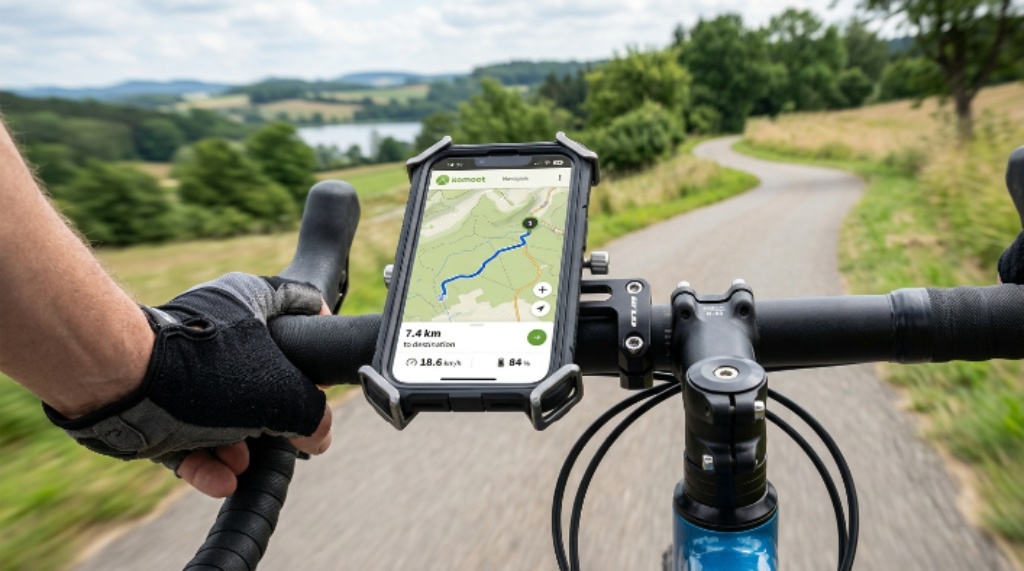
How to Test a New Bike Phone Mount
Test the mount before taking it on a long ride. Start with a stationary inspection, then perform a short ride near home.
First, confirm that every clamp, latch, strap, and locking point sits correctly. Next, place your phone inside and gently test the connection from several directions.
Then ride over familiar pavement at moderate speed. Check whether the phone shifts, rotates, rattles, or interferes with your controls.
Finally, test the mount on the type of surface you normally ride. A mount that works on smooth asphalt may behave differently on gravel or broken pavement.
Navigation Safety Still Comes First
A phone mount improves navigation access, but it should not encourage constant screen viewing. NHTSA recommends riding responsibly and keeping both hands on the handlebars except when signaling.
Set your destination before starting whenever possible. Use voice guidance when practical and glance at the screen only when conditions allow.
If traffic becomes complicated, pull over before studying the map. A reliable mount should support safer riding habits rather than replace them.
The Best Choice Depends on Your Riding Conditions
For daily commuting, prioritize easy installation, secure gripping, weather resistance, and convenient viewing. For long distance road riding, focus more heavily on stability, vibration control, and navigation visibility.
For gravel riding, prioritize strong retention and controlled vibration. For mountain biking, look for robust locking hardware and a mounting system designed for repeated impacts.
For casual recreational riding, a simpler universal mount may provide enough performance. You do not need the most complicated system if your riding conditions remain predictable.
Final Buying Decision
The right bike phone mount should disappear into your riding routine. You should notice the navigation screen when needed, but you should not constantly notice the mount moving or requiring adjustment.
Start with compatibility, then evaluate stability, vibration control, viewing angle, installation, and weather resistance. After that, consider convenience features such as quick release systems and rotation.
Most importantly, match the mount to your real riding environment. A carefully matched mount will provide better navigation, fewer distractions, and greater confidence every time you ride.
FAQs
What is the most important feature of a bike phone mount?
A secure locking mechanism is the most important feature because it prevents accidental phone release during riding.
Is a bike phone mount safe for navigation?
Yes, a bike phone mount can support safer navigation when riders make brief glances and avoid adjusting the phone while moving.
Should a bike phone mount have vibration damping?
Vibration damping is useful for riders who frequently travel rough roads, gravel paths, or surfaces with repeated impacts.
Can one bike phone mount fit every smartphone?
No, compatibility varies by phone dimensions, case thickness, mounting interface, and the holder’s adjustment range.
Is a handlebar or stem phone mount better?
A handlebar mount suits most riders, while a stem mount can provide a more centered position on compatible bicycles.
Conclusion
Choosing a bike phone mount becomes easier when you judge it by riding conditions rather than appearance. Prioritize secure retention, phone compatibility, stability, vibration control, clear viewing, and safe cockpit placement. Then test the mount before trusting it on a long ride, especially if your routes include rough surfaces. A good mount should make navigation easier while keeping your attention where it belongs, on the road.
Call to action: Measure your phone, case, handlebar, and available mounting space first, then use the checklist above to narrow your options. That simple process can help you find a mount that stays secure and works naturally with your everyday riding habits.


