

Choosing your first fishing rod and reel combo can feel surprisingly overwhelming. Walk into any tackle shop, and you are greeted by a wall of graphite, fiberglass, and composites, each with cryptic numbers about length, power, and action. The reality is that most beginners overthink this process. They worry about buying the “wrong” gear, but the wrong choice is usually just a combo that is either too stiff, too long, or too complicated for the fish they are chasing. You likely want gear that is easy to cast, forgiving to learn on, and versatile enough to handle a few different fishing styles without breaking the bank. In this guide, we will cut through the marketing jargon and break down exactly what to look for in your first setup, helping you match the gear to your local waters and target species.
Key Takeaways
- A medium-power, fast-action spinning rod between 6’6″ and 7’0″ is the most versatile starting point for freshwater beginners.
- Spinning reels are significantly easier to learn with than baitcasters due to the lower risk of tangled line (backlash).
- Sizing matters more than brand prestige; match the reel size to the rod weight to keep the balance comfortable.
- You don’t need a massive budget. A quality entry-level combo priced slightly above the bare minimum often provides the best longevity and reliability.
Understanding the “All-Around” Beginner Setup
If the search intent is to find a singular recommendation for a new angler, the answer is almost universally the same: a 6’6″ to 7’0″ Medium-Power, Fast-Action Spinning Rod paired with a 2500-size spinning reel. This combination handles a wider range of techniques than any other setup on the market. It is light enough to cast small lures for panfish and trout for hours without fatigue, yet has enough backbone to battle a solid bass or catfish. The spinning reel design also allows for lighter lures to be cast farther with less effort, making it the superior choice for learning proper casting mechanics.
Why Spinning Reels Are Recommended Over Baitcasting
Baitcasting reels offer casting accuracy and power, but they have a notoriously steep learning curve, often resulting in a “bird’s nest” tangle if you use your thumb incorrectly. For a beginner, this frustration can end the hobby before it truly begins. Spinning reels, conversely, sit below the rod and utilize a fixed spool. You simply open the bail, hold the line with your index finger, and release it during the cast. The physics of this design prevent the severe backlash that plagues baitcasters. While you may occasionally get wind knots with braided line, spinning gear is undeniably the most forgiving platform for novices.
Decoding the Specs: A Practical Fishing Rod Length and Power Guide
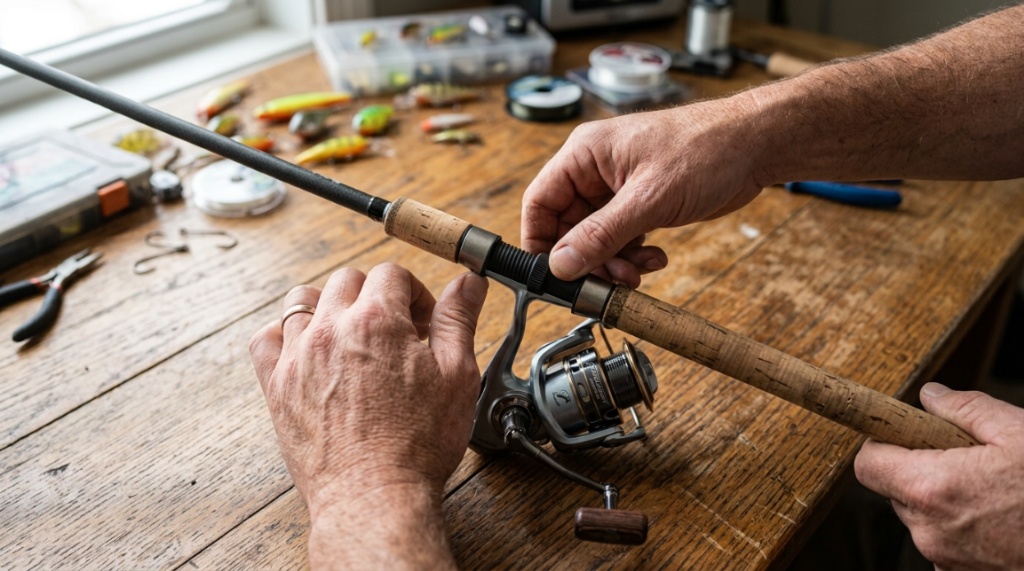
To understand why that medium combo is the right choice, you need to understand what the specifications actually mean for your fishing experience. The two most crucial specs printed on the rod blank are Power and Action. Power refers to the rod’s resistance to bending (how much weight it takes to flex it), while Action refers to where the rod bends along the blank. A common mistake is assuming the numbers indicate quality; they are just sizing for specific jobs.
Before you settle on a specific model, you should brush up on the specifics of rod anatomy to avoid confusion in the store. If you want to dig deeper into material differences and specific lure ratings, our fishing rod length and power guide offers a detailed breakdown. For beginners, the “Medium” power rating indicates the rod has a moderate flex that suits hooks sizes 4 through 1/0 and lures weighing between 1/4 and 3/4 ounces. The “Fast” action means the rod bends mostly near the tip, giving you quick hook-setting power while keeping casting distance acceptable.
Matching Length to Your Environment
Rod length dictates leverage and casting distance. While a 7’0″ rod casts further, a 6’6″ rod is slightly easier to maneuver if you are fishing in tight, tree-lined creeks or small ponds. If you are planning to fish large reservoirs or rivers where distance is a premium, lean toward the 7’0″ length. If you are a bank angler dealing with overhanging branches, stick to the 6’6″ to keep your casts accurate and avoid snags. The 6’6″ option is also advantageous for younger or smaller-framed anglers as it is easier to handle.
Selecting the Correct Reel Size for Balance
In the spinning reel world, sizes range from 500 (ultralight) to 10000 (heavy saltwater). A size 2500 is considered the “sweet spot” for freshwater bass, walleye, and inshore species. This size reel has a spool large enough to hold approximately 150 yards of 10-pound braid, which is sufficient for most freshwater scenarios. More importantly, the physical weight of the 2500 reel balances perfectly on a Medium power rod. If you put an oversized 4000 reel on a 6’6″ medium rod, the setup becomes “tip heavy,” making it uncomfortable to hold for extended periods and reducing sensitivity to light bites.
Gear Ratio: Retrieving Speed
Within that 2500 size, you will see gear ratios like 5.2:1 or 6.2:1. This number indicates how many times the spool rotates with one turn of the handle. For a beginner, the gear ratio is less critical, but you generally want a ratio around 6.2:1 (often labeled as 6.2). This is a “medium-high” speed retrieve, allowing you to reel in slack line quickly when using soft plastics or to crank a spinnerbait at a moderate pace. Avoid the slower 4.0:1 ratios designed for deep-diving crankbaits, as they feel sluggish when you are just learning to maintain tension,If you travel frequently and want to take your hobby on the road, check out our guide on how to Enjoy Fishing as a Business Traveler Using Budget Gear.
Selecting The Best Budget Range
When browsing combos, you will see prices from $20 to over $300. For a beginner, avoid the absolute bottom barrel ($20–$30). These combos often use poor-quality plastic gears in the reel that strip out after a few uses and rod guides that break easily. Similarly, do not fall for the $200+ high-end graphite rods; you won’t yet have the casting skill to utilize their sensitivity, and they are fragile if you whack them on the boat dock or car roof.
You should target a price range of $60 to $120 for a complete combo. This price bracket provides a functional graphite or graphite-composite rod with stainless steel guides and a reel with at least 4 ball bearings. A reel in this class will feature a machined aluminum spool and a smoother drag system, which is vital for fighting a fish that makes a sudden, powerful run without breaking your line.
Common Mistakes Beginners Make When Buying Combo
Even with the right specs in mind, many new anglers still make avoidable purchasing errors. The first is buying a “Spincast” combo. These are the closed-face reels with the push-button casting mechanism. While they are marketed as foolproof for kids, they fail at casting light lures and are notoriously difficult to repair when the internal gears corrode.
A second common mistake is buying a heavy or extra-heavy rod “just in case” you hook something big. Using a heavy rod prevents you from casting lighter, more effective lures like weightless worms or small crankbaits. You end up limiting your presentation options, which drastically reduces your hookup rate. It is better to stick with the Medium power rod and trust that your drag system will protect you against the occasional large fish.
Testing the Balance in the Store
You cannot assess the quality of a combo by looking at the pictures online. You need to visit a physical store to feel the “dead weight” of the setup. Pick up the combo and hold it as if you were casting. If the tip sags toward the floor heavily, the combination is poorly balanced. A well-balanced combo should feel neutral in your hand, resting naturally with your wrist at a comfortable angle. This ergonomic factor is the difference between a day of fatigue and a day of enjoyable fishing.
Final Thoughts on Your First Setup
Purchasing your first combo should simplify your introduction to the sport, not complicate it with “gear acquisition syndrome.” By focusing on a versatile Medium/Fast spinning setup, you arm yourself with a tool that acts as a jack-of-all-trades. You will be able to throw topwater frogs, drop-shot rigs, and lipless crankbaits effectively as you refine your skills. As you grow, you will likely discover specialized niches—like finesse bass fishing or heavy swimbait fishing—which will inform your second and third purchases. For now, trust the process: get the 2500 reel, pair it with the 6’6″ to 7’0″ rod, spool it with 10-15 lb braid, and start practicing your casting accuracy in the backyard before you hit the water.
Frequently Asked Questions
What is the difference between Medium and Medium-Heavy power?
Medium power rods are suited for lures between 1/4oz and 3/4oz and lighter line (6–12 lb). Medium-Heavy rods handle heavier lures (1/2oz–1oz) and heavier line, but they reduce your ability to cast light finesse baits effectively. Beginners should start with Medium unless fishing heavy cover or thick weeds.
Should I buy a one-piece or two-piece rod?
For beginners, a two-piece rod offers superior portability, especially if you are walking, biking, or have a small car. There is no significant performance loss in modern two-piece rods compared to one-piece rods in the entry and mid-price ranges, as the ferrule joint is typically well-constructed.
How much line should I put on my spinning reel?
Your line should fill the spool to within roughly 1/8 of an inch from the spool lip. Overfilling causes the line to spring off the spool leading to tangles. Underfilling reduces casting distance and increases friction. Fill it almost to the edge, but not flush.
Can I use braided line on a beginner spinning combo?
Yes, braided line (10–15 lb test) is highly recommended for beginners because it has zero stretch, which provides better hooksets and sensitivity. However, you must use a monofilament or fluorocarbon leader (about 2-3 feet) when throwing treble-hook lures or fishing in ultra-clear water, as braid is highly visible to fish.
What is the ideal length for fishing from a kayak?
When seated in a kayak, a rod shorter than 8 feet is ideal. A 7’0″ rod is the maximum recommended length for most kayak fishing scenarios, as it offers the casting distance needed to reach fish while keeping the tip manageable for fish that run directly under the kayak.
Is it better to buy a rod and reel separately or as a combo?
In the beginner price range ($60–$120), buying a combo package is generally better because manufacturers tune the balance and match the reel size to the rod. Buying separately only makes sense at higher price points ($150+) when you want specific components from different brand lines.
Conclusion
Selecting the best fishing rod and reel combo doesn’t require a degree in tackle engineering. The ideal first setup allows you to learn casting mechanics without fuss and adapts to the changing seasons and fish behavior. Stick with a 2500 series spinning reel mounted on a 6’6″ to 7’0″ Medium power, Fast action rod. By respecting the fishing rod length and power guide principles—matching your tackle to your environment and target species—you set yourself up for success. Remember to keep the drag set loose until you feel the weight of the fish, and spend more time on the water than in the tackle shop.


