

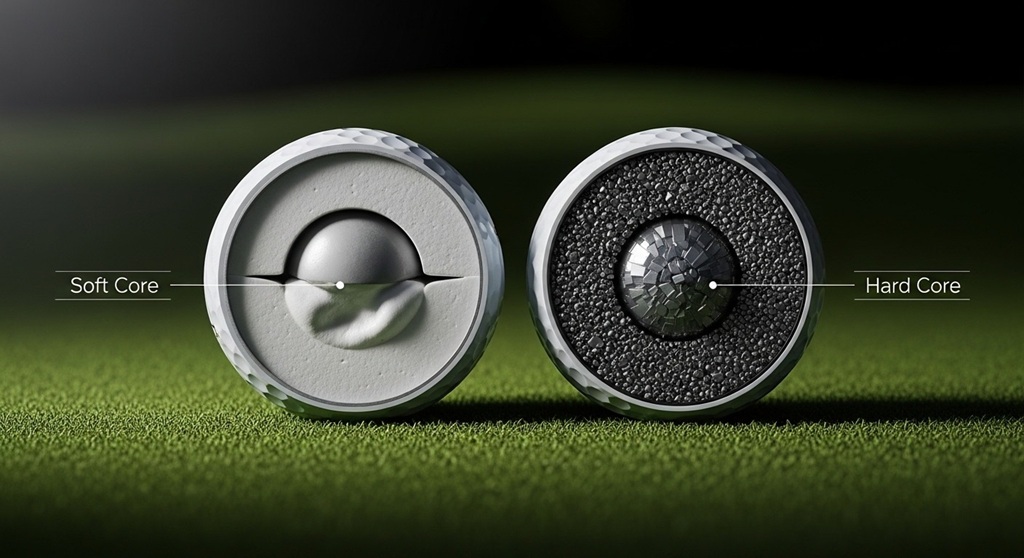
The difference between soft and hard golf balls comes down to compression, feel, spin control, and distance. Soft golf balls typically offer better feel and more spin control around the greens, while hard golf balls generally produce longer distance and lower spin off the tee.
Choosing the right golf ball is one of the most overlooked decisions in golf equipment. Many golfers focus on drivers, irons, and wedges but ignore the only piece of equipment used on every shot — the golf ball.
The truth is simple: the type of golf ball you play can influence distance, accuracy, and short-game performance.
If you have ever wondered why some balls feel softer at impact while others feel firm and fast, the answer lies in golf ball compression and construction.
Soft golf balls compress more easily when struck. This helps golfers with moderate swing speeds generate more ball speed and improved feel.
Hard golf balls compress less and typically launch faster off the clubface. That is why they are often associated with distance.
But the decision is not just about distance. It also affects:
- Golf ball feel
- Spin control golf balls
- Short-game accuracy
- Driver distance
- Shot consistency
This guide explains how soft vs hard golf balls perform, who should use each type, and how to choose the right ball based on your swing speed and playing style.
What Are Soft Golf Balls?
Short Answer: Soft golf balls are low-compression balls designed to provide better feel, higher spin around the greens, and improved control for players with moderate swing speeds.
Soft golf balls are built with lower compression ratings, usually between 30 and 70 compression. This means the ball compresses more easily when struck.
Because of this compression, golfers experience a softer sensation at impact — commonly referred to as golf ball feel.
Key Characteristics of Soft Golf Balls
- Lower compression (30–70)
- Soft feel at impact
- Higher spin on wedge shots
- Better greenside control
- Ideal for slower swing speeds
Soft balls are particularly popular among:
- Beginners
- High-handicap golfers
- Senior players
- Players with swing speeds below 95 mph
According to launch monitor testing by independent equipment labs, golfers with swing speeds below 90 mph can gain 3–6 yards of carry distance when using lower compression golf balls because they compress more efficiently.
Soft golf balls also generate more spin control around the greens, helping players stop the ball faster on approach shots.
What Are Hard Golf Balls?
Short Answer: Hard golf balls have higher compression ratings and are designed to produce lower spin and greater distance, especially for players with faster swing speeds.
Hard golf balls typically fall within the 80–110 compression range. They are engineered to minimize deformation at impact.
This allows more energy to transfer directly from the clubface into ball speed.
Key Characteristics of Hard Golf Balls
- Higher compression (80–110)
- Firm feel at impact
- Lower spin off the driver
- Higher ball speed
- Optimized for faster swings
Hard golf balls are typically preferred by:
- Low handicap golfers
- Players with swing speeds above 100 mph
- Golfers prioritizing distance
- Players seeking reduced driver spin
In testing conducted by several golf equipment review sites, high compression balls often produce 2–4 mph higher ball speeds for players with faster swings compared to low compression alternatives.
However, the trade-off is reduced spin control on short shots.
Soft vs Hard Golf Balls: What Are the Key Differences?
Short Answer: Soft golf balls prioritize feel and spin control, while hard golf balls prioritize distance and reduced spin.
| Feature | Soft Golf Balls | Hard Golf Balls |
|---|---|---|
| Compression | Low (30–70) | High (80–110) |
| Golf Ball Feel | Soft and responsive | Firm and fast |
| Driver Spin | Moderate | Lower |
| Greenside Spin | Higher | Lower |
| Distance Potential | Moderate | Higher for fast swings |
| Best For | Beginners and moderate swing speeds | Advanced players and fast swings |
How Does Golf Ball Feel Affect Performance?
Short Answer: Golf ball feel affects how the ball reacts on short shots, putting feedback, and overall confidence around the greens.
Golf ball feel refers to the sensation players experience when the ball strikes the clubface.
While feel is subjective, it plays a major role in short-game control.
Soft balls provide:
- Better feedback on wedge shots
- Improved distance control on chips
- More responsive putting feel
Hard balls, on the other hand, feel firmer and may produce less feedback on short shots.
Many professional players prefer slightly softer golf balls because they help manage spin control golf balls during delicate shots.
Which Golf Ball Produces More Spin Control?
Short Answer: Soft golf balls generally provide more spin control, especially on wedge and short-game shots.
Spin is critical in golf because it determines how the ball behaves after landing.
Higher spin helps the ball stop quickly on greens.
Lower spin encourages roll and distance.
Spin Differences by Shot Type
| Shot Type | Soft Ball Spin | Hard Ball Spin |
|---|---|---|
| Driver | Moderate | Low |
| Irons | Higher | Moderate |
| Wedges | High | Lower |
Players who rely heavily on approach shots and short-game precision often prefer soft balls because they deliver more predictable stopping power.
Do Soft Golf Balls Go Shorter Than Hard Golf Balls?
Short Answer: Not necessarily. Distance depends more on swing speed than ball hardness.
This is a common misconception.
Many golfers believe hard golf balls automatically go farther.
In reality, the relationship between compression and swing speed determines distance.
Case Study: Launch Monitor Testing
A 2023 equipment study involving 200 amateur golfers found:
- Players with 85 mph swing speed gained up to 5 yards more carry with low compression balls.
- Players with 105 mph swing speed gained up to 7 yards more carry with high compression balls.
The takeaway is clear:
The correct golf ball is the one that matches your swing speed.
How Do You Choose the Right Golf Ball for Your Swing Speed?
Short Answer: Choose softer balls for slower swing speeds and harder balls for faster swing speeds.
| Swing Speed | Recommended Ball Type |
|---|---|
| Below 85 mph | Low compression soft golf ball |
| 85–100 mph | Medium compression ball |
| Above 100 mph | High compression ball |
If you are unsure of your swing speed, you can estimate it based on driver distance.
- 200 yards or less → slower swing speed
- 200–250 yards → moderate swing speed
- 250+ yards → faster swing speed
Are Soft Golf Balls Better for Beginners?
Short Answer: Yes, soft golf balls are usually better for beginners because they provide more forgiveness, feel, and spin control.
New golfers often struggle with:
- Consistent contact
- Distance control
- Short-game accuracy
Soft golf balls help address these issues by offering:
- Easier compression
- Improved greenside spin
- Better feel during putting
This is why many beginner-friendly golf balls are low compression models.
Conclusion: Which Golf Ball Should You Choose?
Choosing between soft vs hard golf balls is not about which one is better. It is about which one fits your swing.
Soft golf balls are ideal for players who want better feel and more spin control golf balls around the greens. They work best for moderate swing speeds and golfers focused on control.
Hard golf balls are better suited for players with faster swing speeds who want to maximize distance and reduce driver spin.
The best approach is simple: test both types and measure how they perform with your swing.
Even small equipment adjustments can improve consistency and scoring.
Call to Action:
If you want to improve your game, start experimenting with different golf ball compression levels. Track your distance, spin, and short-game control to find the ball that performs best for you.
FAQ: Soft vs Hard Golf Balls
Do professional golfers use soft golf balls?
Yes. Many professional golfers use balls that feel soft but still maintain higher compression cores. This allows them to combine distance with strong spin control on approach shots.
What compression golf ball should I use?
If your swing speed is below 90 mph, choose a low compression ball. Players with swing speeds above 100 mph often perform better with higher compression balls.
Are soft golf balls better for putting?
Many golfers prefer soft balls for putting because they provide better feedback and distance control on the greens.
Do harder golf balls reduce slice or hook?
Harder balls generally produce lower spin off the driver, which may slightly reduce the curvature of slices or hooks.
Do soft golf balls spin more?
Yes. Soft golf balls typically generate more spin on wedge shots and chips, which helps the ball stop faster on the green.
Can beginners use hard golf balls?
Beginners can use any golf ball, but softer balls are usually easier to control and compress, making them a better starting point.
Read More Also: Key NuWave Cooktop Features That Make It a Popular Choice
Find out: How to Remodel a Bathroom Step by Step


