

If you’ve ever stood in a hardware store comparing tools, you’ve likely asked yourself a common question: Should I choose cordless or corded power tools? The answer isn’t always simple. Each option offers unique benefits depending on your project type, work environment, and usage frequency.
Corded power tools run directly on electricity through a power outlet, providing consistent energy and strong performance. Cordless power tools, on the other hand, operate on rechargeable batteries, offering mobility and convenience.
Over the last decade, cordless technology has improved dramatically. According to industry reports from the Power Tool Institute, modern lithium-ion batteries can deliver up to 3–4 times longer runtime than early battery models introduced in the early 2000s.
This shift has changed the power tool comparison landscape. Contractors, DIY homeowners, and construction professionals now regularly debate the advantages of cordless tools versus the raw power and reliability of corded options.
In this guide, we’ll break down the real differences between cordless and corded tools. You’ll learn:
- Which tool type delivers better performance
- When cordless tools make more sense
- When corded tools are still the better investment
- How professionals decide between the two
By the end, you’ll know exactly which option fits your workflow and budget.
Why Are Cordless Power Tools Becoming So Popular?
Short answer: Cordless power tools are popular because they provide mobility, convenience, and improved battery performance without sacrificing much power.
The biggest shift in the power tool comparison debate happened when lithium-ion batteries replaced older nickel-cadmium batteries.
Modern cordless tools now offer:
- Longer battery life
- Shorter charging times
- Higher torque output
- Lighter tool designs
According to a 2023 industry report by Grand View Research, the global cordless power tools market exceeded $20 billion and continues to grow rapidly due to increasing demand from construction and home improvement sectors.
Key Advantages of Cordless Tools
- No cables or extension cords required
- Easy use in tight or remote spaces
- Portable for outdoor and rooftop work
- Safer when working on ladders or scaffolding
For example, roofing contractors often rely on cordless nail guns and drills because dragging cords across rooftops increases tripping hazards.
For many professionals, the advantages of cordless tools now outweigh the traditional benefits of corded models.
What Are the Main Advantages of Corded Power Tools?
Short answer: Corded tools provide continuous power, higher torque, and lower long-term costs.
Despite the cordless boom, corded tools remain essential for heavy-duty work.
Because they plug directly into electricity, corded tools do not depend on batteries. This means they can run for hours without losing performance.
Main Benefits of Corded Tools
- Consistent power output
- No battery charging downtime
- Lower purchase cost
- Ideal for long continuous jobs
In construction environments, corded tools are still common for:
- Circular saws
- Angle grinders
- Demolition hammers
- Table saws
For example, demolition contractors prefer corded rotary hammers because battery tools may lose performance during extended heavy drilling.
In many situations, corded tools still deliver the most reliable power.
How Does Performance Compare Between Cordless and Corded Tools?
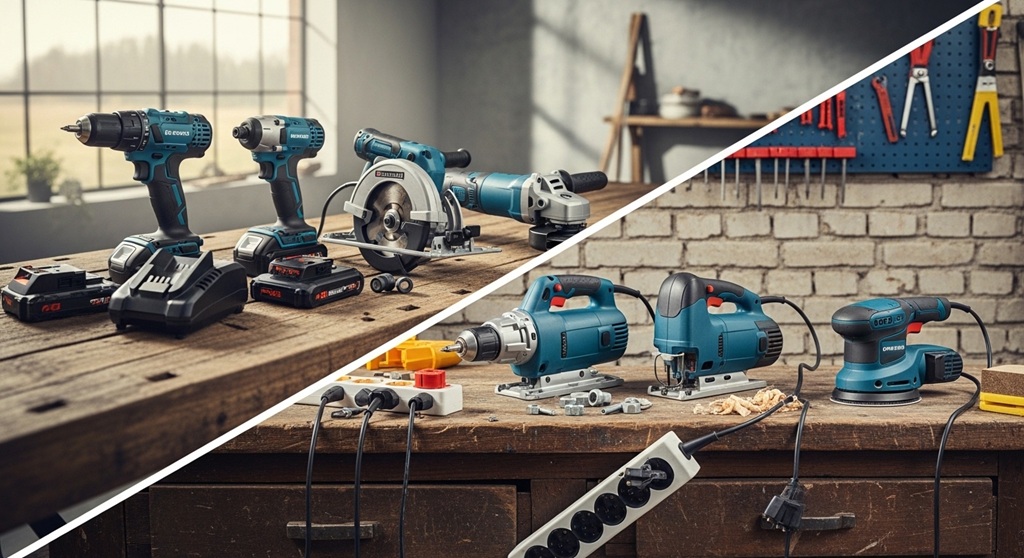
Short answer: Corded tools generally deliver higher continuous power, while modern cordless tools offer comparable performance for most everyday tasks.
Performance is one of the biggest concerns in any power tool comparison.
Historically, cordless tools lacked torque and runtime. However, improvements in brushless motors and lithium-ion batteries have closed the gap significantly.
| Feature | Cordless Tools | Corded Tools |
|---|---|---|
| Power Output | High, but battery dependent | Very high and consistent |
| Runtime | Limited by battery | Unlimited while plugged in |
| Portability | Excellent | Limited by cord length |
| Maintenance | Battery replacement needed | Minimal maintenance |
| Initial Cost | Higher | Usually lower |
For most homeowners and DIY users, modern cordless tools provide enough performance for everyday jobs such as drilling, assembling furniture, and light carpentry.
When Should You Choose Cordless Power Tools?
Short answer: Choose cordless tools when portability, flexibility, and mobility matter more than continuous power.
Cordless tools excel in situations where access to electricity is limited.
Best Use Cases for Cordless Tools
- Outdoor construction projects
- Roofing work
- Ladder or scaffold jobs
- Quick home repairs
- Remote job sites
Case study example:
A small remodeling team working on residential projects reported a 22% reduction in setup time after switching to cordless drills and impact drivers. Workers no longer needed to run extension cords across multiple rooms.
This shows how the advantages of cordless tools can improve productivity.
When Are Corded Tools the Better Choice?
Short answer: Corded tools are better for long, heavy-duty tasks requiring uninterrupted power.
If your project demands continuous high torque, corded tools remain the safer choice.
Best Situations for Corded Tools
- Workshop environments
- Large construction sites with power access
- Heavy material cutting
- Concrete drilling
- Metal grinding
Professional carpentry shops still rely on corded table saws and routers because they provide stable power for precision cutting.
Battery tools may struggle during extended use under these conditions.
How Do Battery Technology and Brushless Motors Impact Cordless Tools?
Short answer: Lithium-ion batteries and brushless motors dramatically improved cordless tool efficiency and power.
Two innovations transformed cordless tool performance.
1. Lithium-Ion Batteries
- Higher energy density
- Lighter weight
- No memory effect
- Faster charging
2. Brushless Motors
Brushless motors improve efficiency by reducing friction.
Benefits include:
- Longer tool lifespan
- Less heat generation
- Better energy efficiency
- Higher torque output
Many premium cordless brands now rely entirely on brushless motor technology.
Which Option Is More Cost-Effective Over Time?
Short answer: Corded tools cost less initially, while cordless tools may require battery replacements over time.
Cost is an important factor in the cordless vs corded debate.
Corded Tool Costs
- Lower upfront price
- No batteries required
- Minimal maintenance
Cordless Tool Costs
- Higher initial purchase
- Battery replacements every few years
- Additional chargers and batteries
However, many professionals justify cordless investments due to productivity improvements and convenience.
Conclusion: Which Power Tool Type Should You Choose?
Choosing between cordless and corded tools ultimately depends on your work environment and project requirements.
If you prioritize mobility, flexibility, and ease of use, cordless tools are often the better choice. Modern lithium-ion batteries and brushless motors make them powerful enough for most construction and DIY tasks.
If you need continuous power, heavy-duty performance, and lower upfront cost, corded tools still hold a strong advantage.
The smartest strategy used by many professionals is to combine both options. Cordless tools handle portable jobs, while corded tools tackle high-power applications.
CTA: If you’re planning to upgrade your workshop or tool collection, evaluate your most common projects first. The right power tool choice can improve efficiency, reduce downtime, and help you complete jobs faster.
Frequently Asked Questions
Are cordless power tools powerful enough for professional work?
Yes. Modern cordless tools using lithium-ion batteries and brushless motors provide enough power for most professional tasks including drilling, fastening, and light cutting.
Do corded tools last longer than cordless tools?
Corded tools often last longer because they do not rely on rechargeable batteries, which degrade over time. However, high-quality cordless tools can still last many years with proper care.
What is the biggest advantage of cordless tools?
The biggest advantage of cordless tools is portability. Users can work anywhere without needing power outlets or extension cords.
Are corded tools cheaper?
Yes. Corded tools typically cost less upfront because they do not include batteries or chargers.
How long do cordless tool batteries last?
Most lithium-ion batteries last between 2 to 5 years depending on usage frequency and charging habits.
Do professionals still use corded tools?
Yes. Many professionals still rely on corded tools for heavy-duty applications such as demolition, concrete drilling, and metal grinding.
Read More Also: How to Select the Best Tools for Remote Work Success
Find out: How to Choose the Best HelloBaby 6″ IPS Baby Monitor: Complete Review


